Freelance strategy
Is Upwork Dead in 2026? What Freelancers Should Do Now
Is Upwork still worth it in 2026? New U.S. data shows freelancing is growing while AI squeezes routine work and rewards judgment-led services.


Upwork is not dead, but the boundaries of valuable freelance work are being redrawn. In July 2026, Upwork reported that the share of skilled U.S. knowledge workers who freelance had risen from 28% to 38% in one year. The same research found a sharp divide inside AI work: complex, judgment-led work earned more, while some fast-growing execution work earned less per contract.
New OpenAI usage research helps explain the split. People are using AI to perform tasks that historically belonged to other occupations. That gives clients more ability to complete basic work themselves. It also gives capable freelancers the ability to solve a broader problem without waiting for several specialists.
The useful response is therefore not “send more proposals,” “learn every AI tool,” or “quit freelancing.” Keep one credible specialty, absorb a small number of adjacent tasks with AI, and sell an outcome for which you can remain accountable. Then pursue fewer opportunities where that combination is unusually relevant.
What the latest Upwork numbers say
Upwork's latest reported results are useful because they show both weakness and resilience at the same time.
| Upwork-reported metric | Q1 2025 | Q1 2026 | What it suggests |
|---|---|---|---|
| Active clients | 812,000 | 784,000 | The pool of clients who spent in the preceding 12 months shrank |
| Gross services volume | About $988 million | $987.1 million | Total marketplace spend was approximately flat |
| GSV per active client | $4,912 | $5,138 | Remaining active clients spent more on average |
| AI-related work GSV growth | Not stated here | More than 40% year over year | AI-related demand is growing rapidly from its existing base |
Sources: Upwork's Q1 2025 results and Q1 2026 results.
These are company-reported marketplace metrics, not independent measures of an individual freelancer's opportunity. Still, the direction is important: fewer active clients, roughly flat total spend, and more spend per active client.
That is not a dead marketplace. It is a marketplace becoming more concentrated.
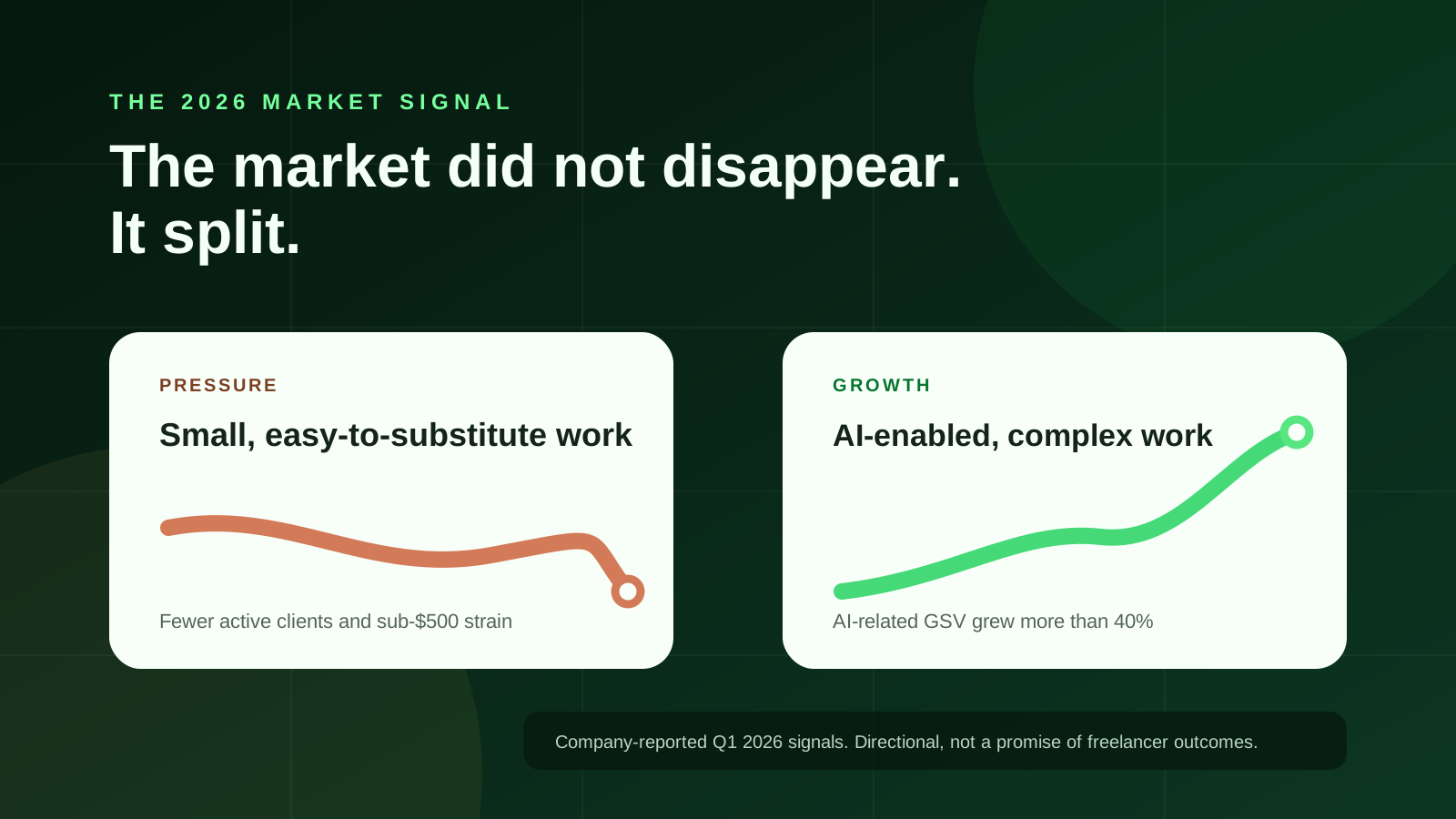
Upwork's prepared Q1 2026 remarks add a sharper detail. The company said demand slowed materially from late February through early April and that its greatest pressure remained in contracts below $500. It also estimated that tasks representing about 10% of platform GSV were in an “AI at-risk” category, concentrated in the smallest jobs.
That estimate comes from Upwork's own model and should be treated as a company claim, not neutral proof. But it aligns with the broader pattern: the most replaceable, smallest pieces of work face the strongest pressure.
Source: Upwork's Q1 2026 prepared remarks.
Freelancing is growing, but not every kind of freelance work is gaining value
Upwork's July 2026 Future Workforce Index adds a different view. It combines a survey of 2,400 U.S.-based skilled knowledge workers with selected Upwork marketplace data.
| Upwork-reported 2026 finding | Result | Practical reading |
|---|---|---|
| Skilled U.S. knowledge workers who freelance | 38%, up from 28% | Freelancing is expanding, not disappearing |
| Full-time workers considering freelancing | 58%, up from 36% | More people may also compete for independent work |
| Hourly premium for freelancers doing AI work | 34% | AI capability can command value, but the category is broad |
| Earnings growth in more complex AI work | 45% year over year | Expertise and judgment appear to matter more at higher complexity |
| AI-augmented professional-services volume | Up 72% | Domain professionals are adding AI to established services |
| Generative-AI and creative-production contract starts | Up 90% | Demand can grow even while work becomes more competitive |
| Earnings per contract in that last category | Down 13% | More jobs do not automatically mean better economics |
Source: Upwork, “Future Workforce Index 2026”, July 14, 2026.
The apparent contradiction is the point. Freelancing can grow while routine freelance work becomes less attractive. When a capability becomes easier to access, more clients can buy it and more workers can offer it. Volume may rise while scarcity—and therefore the price of basic execution—falls.
Upwork describes the higher-value worker emerging from this shift as an “AI Orchestrator”: someone who connects AI tools with domain expertise, applies judgment, and remains responsible for the business result. The label is company language, but the underlying distinction is useful. A freelancer who merely operates a tool is easier to compare on price than one who can frame the problem, direct the workflow, catch failure, and defend the result.
These figures are Upwork-sponsored research, not an independent census of all U.S. freelancers or a prediction of what an individual will earn. The survey covers skilled U.S. knowledge workers, while the earnings findings come from Upwork's own marketplace classifications. They are best treated as current directional evidence.
AI is not only replacing tasks. It is moving them
OpenAI Economic Research analyzed more than 800,000 work-related messages from U.S. ChatGPT users across eight occupation groups. It calls the pattern task crossover: people using AI for work historically associated with another occupation.
- 16.8% of all work-related messages in the sample involved cross-occupation tasks.
- Once generic activities such as routine writing and scheduling were excluded, 43.5% of occupation-specific messages crossed an occupational boundary.
- Cross-occupation tasks represented 75% of occupation-specific messages from designers, 53% from marketers, and 77% from customer-experience workers.
- Among typical-volume users, crossover was somewhat higher in workspaces with 2–5 seats than in those with more than 100 seats.
Sources: OpenAI, “How AI is expanding what people do at work” and the full Work at the Frontier report, July 27, 2026.
For freelancers, task crossover cuts both ways.
Clients can cross into work they previously outsourced. A small-business owner can draft basic copy, inspect a spreadsheet, troubleshoot a website, or prepare an initial analysis without immediately hiring four specialists. Small, cleanly specified handoffs therefore face more pressure.
Freelancers can cross into adjacent work and own more of the outcome. A designer can combine research, campaign logic, production, and testing. A developer can add workflow diagnosis, documentation, and evaluation. A finance professional can use AI for analysis while retaining responsibility for controls and interpretation.
This is not evidence that specialists have stopped mattering. The OpenAI study measures messages, not hours worked, completed projects, output quality, productivity, or employment. Its sample is not representative of the entire U.S. workforce. The stronger conclusion is narrower: the old handoff boundaries are becoming easier to cross.
The “AI took the jobs” concern has real evidence behind it
The difficult part of this discussion is resisting two bad extremes:
- “AI has changed nothing; just improve your proposals.”
- “AI has destroyed freelancing; there is no point trying.”
Independent research supports a more specific conclusion. The strongest recent evidence is not perfectly consistent, which is exactly why broad claims about AI “killing all jobs” should be treated carefully.
A January 2026 working paper from Ramp Economics Lab tracked spending by thousands of businesses from 2021 through Q3 2025. Among its selected sample, the share of spending going to online labor marketplaces fell from 0.66% in Q4 2021 to 0.14% in Q3 2025. More than half of businesses that used online labor marketplaces in Q2 2022 spent nothing on them in Q2 2025. The paper found that firms most exposed to potential AI substitution moved away from marketplace labor faster.
This is unusually direct evidence of freelance-market pressure, but it has limits. The dataset covers Ramp customers, selected labor marketplaces, and spending with OpenAI and Anthropic; it does not represent every business expense or prove that aggregate labor demand will fall.
Source: Stevens, “Payrolls to Prompts: Firm-Level Evidence on the Substitution of Labor for AI”, January 2026.
Newer economy-wide research is more cautious. Anthropic's March 2026 analysis found no systematic increase in unemployment for highly exposed workers, though it found tentative evidence that hiring of workers aged 22–25 had slowed in exposed occupations. A May 2026 New York Fed analysis of job postings found little indication of a distinct AI-driven decline in labor demand; much of the decline in highly exposed occupations began before ChatGPT.
Sources: Anthropic, “Labor market impacts of AI: A new measure and early evidence”, March 2026; and Federal Reserve Bank of New York, “Do Job Postings Show Early Labor-Market Effects of AI?”, May 2026.
The older platform-specific evidence still matters because it directly studies freelance listings. Research published in Management Science in 2025 found a 21% relative decrease in job posts for automation-prone writing and coding work within eight months of ChatGPT's launch, compared with manual-intensive work. It also found a 17% decrease in image-creation job posts after image-generating AI tools arrived. The remaining automation-prone jobs were more complex and offered higher pay.
Source: Demirci, Hannane, and Zhu, “Who Is AI Replacing? The Impact of Generative AI on Online Freelancing Platforms”, published online in 2025.
The freshest broad study points to a similar split. PwC's June 2026 analysis of more than one billion job ads reports that skills in the most AI-exposed jobs are changing more than twice as fast as in the least exposed jobs. It describes some roles as being “professionalised” by AI, requiring more human expertise, while other roles become easier for non-experts to perform. PwC reports that professionalised roles grew twice as fast as democratised roles and had 42% faster wage growth since 2021.
Source: PwC, “2026 Global AI Jobs Barometer”, June 2026. This is company research about the wider labor market, not a freelance-platform study.
Why jobs can feel cheaper even when the platform still has money
Freelancers experience the market through individual listings, not quarterly GSV. A platform can process nearly $1 billion in a quarter while many users see poor-fit, low-budget, or crowded jobs.
Four forces can make the experience feel worse:
1. Commodity supply became cheaper
AI lowered the cost of producing first drafts, basic images, simple code, summaries, research starting points, and routine administrative output. Clients can do some work themselves, ask for more output at the same price, or compare a larger supply of providers.
2. The easiest tasks are the easiest to describe
Small commodity jobs are simple to post and simple for many freelancers to recognize. That attracts competition. Valuable problems are often messier: the client may need diagnosis, trade-offs, integration, stakeholder management, quality control, or ownership after delivery.
3. AI makes generic applications cheaper too
When anyone can generate a competent-looking proposal in seconds, competent-looking proposals stop being a useful differentiator. Clients face more noise, and freelancers who rely on polished generalities receive less attention.
4. Platform averages hide category differences
Upwork's 2026 skills report says established skills such as full-stack development, general virtual assistance, data analytics, and graphic design remained in demand year over year. It also reports that skills explicitly referencing AI grew 109%, including AI integration and AI video work.
That report uses Upwork's own platform data and should be read as directional company research. It still reinforces the central point: old skills did not uniformly disappear, but clients increasingly want those skills applied in an AI-enabled operating environment.
Source: Upwork Research Institute, “In-Demand Skills 2026”.
The durable business fundamentals that do not change
Tools, platforms, and search algorithms change. The economic reason a client hires does not: they expect the engagement to create more value or remove more risk than it costs.
The strongest freelance offers therefore do at least one of these jobs:
- Increase revenue by helping a client sell, retain, convert, or expand.
- Reduce cost by removing repeated labor, errors, or waste.
- Reduce risk by improving quality, compliance, reliability, or decision confidence.
- Increase speed when timing has real business value.
- Supply scarce judgment the client cannot easily create internally.
“I write articles” is a task. “I build evidence-led comparison pages that help a fintech buyer choose and convert” is closer to a business outcome.
“I create automations” is a capability. “I remove manual reconciliation from your weekly finance workflow, with exception handling and an audit trail” is a risk-adjusted outcome.
The second version is harder to replace because it includes context, accountability, and judgment—not merely production.
What freelancers should do now
Do not respond by collecting a random list of AI skills. Build a T-shaped offer: retain deep credibility in one problem area, then use AI to handle a few adjacent tasks that make the client outcome more complete. Use this five-part operating method for the next 30 days.
1. Diagnose your exposure at the task level
List the tasks clients currently pay you to perform. Mark each one:
- Automatable: AI can produce an acceptable result with little expert review.
- AI-assisted: AI accelerates the task, but expert judgment materially changes the result.
- Human-critical: The task depends on trust, context, accountability, integration, or high-consequence decisions.
Do not label your entire profession “safe” or “dead.” A profession is a bundle of tasks, and clients buy different bundles.
2. Keep one specialty, but package it around a measurable outcome
Choose one client type and one expensive problem. Keep the expertise that lets you judge quality, then add only the adjacent activities needed to reach a useful before-and-after state.
| Weak task offer | Commercially clearer offer |
|---|---|
| Write 10 blog posts | Research and draft a topic cluster mapped to five documented buyer questions |
| Design social graphics | Deliver a reusable launch kit sized for three named channels |
| Build a chatbot | Build a cited support-answer workflow with escalation rules and monitoring |
| Do data entry | Clean and reconcile the dataset, then deliver an exception report |
| Develop a website | Rebuild the lead path, instrument conversion events, and report the results |
3. Use AI to widen your margin of excellence
Competing by doing the same task cheaper is a race with a poor ending. Use AI to improve one or more of:
- Research breadth
- Turnaround time
- Quality assurance
- Scenario exploration
- Documentation
- Client communication
- Reusable systems
Then keep the value, share some efficiency with the client, or deliver a stronger result at the same price. Your advantage is not “I use AI.” It is that you can use AI without transferring its uncertainty to the client.
4. Pursue fewer jobs where your proof is unusually relevant
When competition rises, generic volume becomes expensive. Tighten your pursuit criteria:
- The problem matches work you can prove.
- The client appears able and willing to pay for the outcome.
- The scope requires more than raw production.
- You can explain a specific first step.
- The opportunity is worth your connects, time, and follow-through.
Use the eight-signal Upwork job checklist before writing. A smaller number of thoughtful pursuits gives you better learning than a large number of interchangeable proposals.
5. Build a business that can survive one channel changing
Upwork can be useful without being your entire business.
For every active platform pursuit, create a second path to future demand:
- Ask a satisfied client for a referral or testimonial.
- Turn completed work into a specific case study.
- Publish one useful explanation of a problem your target buyer already has.
- Build a small list of past clients and warm contacts you can help again.
- Develop a repeatable offer that is understandable outside Upwork.
This is not a recommendation to abandon the platform. It is basic concentration-risk management.
A 30-day reality test
Do not decide your future from a bad week or a Reddit thread. Run a controlled test and keep the evidence.
For 30 days:
- Choose one narrow client problem and one outcome-led offer.
- Create or improve two proof assets directly relevant to it.
- Review jobs consistently, but pursue only those that pass your criteria.
- Send tailored proposals that lead with diagnosis and proof.
- Track views, replies, interviews, objections, and the quality of available jobs.
- Contact a small number of relevant people outside Upwork each week.
- Review the result honestly at the end.
If qualified opportunities rarely exist, your market or offer may need to change. If opportunities exist but proposals receive no response, your positioning and proof may be the problem. If interviews happen but deals fail, investigate trust, scope, pricing, and sales conversations.
That diagnosis is far more useful than “Upwork is dead,” because it tells you what to change next.
So, is Upwork still worth it?
Upwork can still be worth it when:
- Your work solves a valuable, specific problem.
- You have proof that reduces client risk.
- You can identify credible opportunities without chasing everything.
- The platform is one part of a wider pipeline.
- You are adapting your delivery and offer as AI changes the task mix.
It may not be worth sustained effort when your category has little viable demand, prices cannot support your economics, or the platform consistently produces worse opportunities than your alternatives.
The honest conclusion is not universally optimistic. Some freelance tasks have already lost demand, more skilled workers are entering freelancing, and some freelancers will need to reposition substantially. But the current data does not show that paid freelance work—or Upwork—has vanished. It shows that value is moving away from isolated execution and toward people who can combine expertise, AI, judgment, and responsibility.
Your job is to move closer to it.
Editorial note and limitations
This article was written and reviewed by Muthukkumaran K., the product builder behind Upwork Goldmine. It was updated on July 29, 2026 with Upwork's Future Workforce Index 2026 and OpenAI's Work at the Frontier research. Upwork Goldmine is an independent product and is not affiliated with or endorsed by Upwork.
The article distinguishes Upwork-reported metrics and research, OpenAI usage research, independent and company research, peer-reviewed evidence, and the author's practical interpretation. Company-reported metrics can be selective. Usage messages are not completed jobs or measured productivity. Working papers may change and do not establish universal effects. No source cited here predicts an individual freelancer's results, and the strategies above do not guarantee work or earnings.